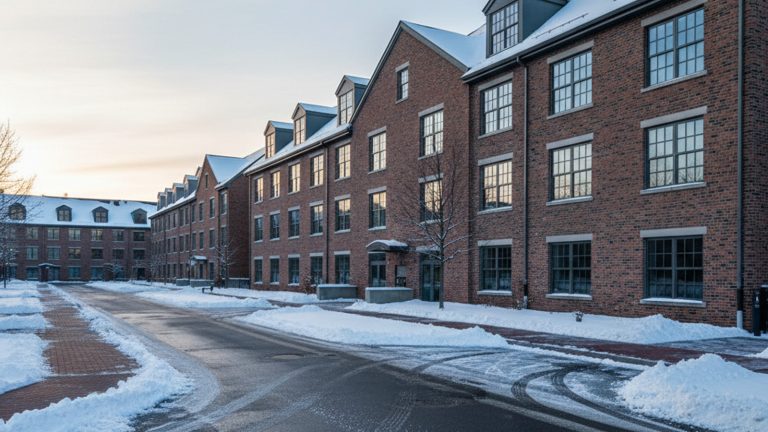


If you follow national real estate news, you’ve likely seen Manchester, New Hampshire, pop up on “Hottest Market” lists repeatedly over the last few years. It’s not an accident. While much of the country has seen demand seesaw, the Queen City has remained remarkably resilient, with homes often moving from “listed” to “pending” in as little as 12 to 15 days.
The primary driver here is simple: value. We often call it “Boston Living at Half the Price.” With a median sale price hovering around $425,000 to $440,000, Manchester offers a significantly lower barrier to entry than the Greater Boston area, where median prices easily eclipse $800,000. For investors, this creates a unique opportunity to capture demand from commuters who are priced out of Massachusetts but still need access to the city.
However, buying here isn’t just about finding a cheap duplex and watching the rent checks roll in. You need to understand the local tax structure, the age of the housing stock, and the specific neighborhood dynamics. In this guide, we’ll walk through the rental yields, the tax trade-offs, and where the smart money is looking in 2026.
Is Manchester NH Real Estate Still Worth It in 2026?
A common question I get from investors—especially those who watched prices climb post-2020—is whether they missed the boat. The short answer is no, but the strategy has changed. The era of explosive, double-digit appreciation overnight has cooled. We are now in a cycle of stabilization, seeing steady, single-digit growth (roughly 1.3% to 6%) that aligns more with historical norms.
The biggest factor keeping Manchester a solid bet is the “Commuter Effect.” Hybrid work models have cemented Southern New Hampshire as a prime location. People are willing to commute 50 minutes to Boston two days a week if it means owning a home with a yard for half the cost of a condo in Somerville. This keeps tenant demand incredibly high for homes for sale in Manchester NH.
More importantly, the floor on prices is protected by a severe inventory crunch. A balanced market usually has 4 to 6 months of housing supply. Right now, Manchester is operating with roughly 1.0 to 1.2 months of supply. Even if interest rates fluctuate, there simply aren’t enough roofs for the heads that want them, which protects your asset value.
The NH Tax Trade-off: No Income Tax vs. Property Tax
If you are an out-of-state investor, specifically coming from Massachusetts or New York, you need to pay close attention to this section. New Hampshire’s tax structure is often a shock to the system if you haven’t run your numbers correctly.
Here is the trade-off: New Hampshire has no state income tax on W-2 wages and no sales tax. This is a massive benefit for your overall portfolio ROI, especially if you plan to eventually move here or have high personal income. However, the state funds its municipalities almost entirely through local property taxes.
This results in some of the highest property tax rates in the country. For the 2026 fiscal year, the tax rate in Manchester is approximately $20.24 per $1,000 of assessed value.
To put that in perspective, if you buy a duplex for $500,000, you should budget roughly $10,120 per year just for property taxes. When calculating your Net Operating Income (NOI), you cannot use national averages for tax expenses. High taxes will eat into your Cap Rate (capitalization rate), but many investors find the lack of income tax and the strong appreciation potential balance the scales over time.
Rental Market Analysis: Yields & Demographics
The good news for landlords is that the rental market is just as tight as the sales market. Vacancy rates in Manchester are incredibly low, often fluctuating between 0.6% and 1.2%. In this environment, finding tenants is rarely the problem; selecting the right tenant is the priority.
The tenant base here is diverse, which offers you options depending on your strategy:
- Student Housing: With Southern New Hampshire University (SNHU) and UNH Manchester expanding, there is consistent demand for housing near the river and downtown.
- Young Professionals: The tech and healthcare sectors in the Millyard, combined with Boston commuters, drive demand for updated units with amenities.
- Workforce Housing: There is significant demand for affordable units, particularly for service workers supporting the local economy.
From a numbers standpoint, the median rent sits around $1,975, though this varies wildly by neighborhood and unit size. If you are running a buy-and-hold strategy, a Cash-on-Cash (CoC) return of 4-6% is a realistic target for a stabilized property in 2026. You might see higher returns on paper in tougher neighborhoods, but maintenance and turnover often level that out.
Where to Invest: Best Neighborhoods in Manchester
Manchester is a city of distinct pockets, often defined by which side of the Merrimack River you are on. Your investment goals—appreciation vs. cash flow—will dictate where you should look.
- The North End: This is the area famous for its historic Victorian homes and tree-lined streets. It commands the highest price points, often well over $500,000. The play here is appreciation and stability. You will likely attract long-term executive tenants, but your monthly cash flow yields will be lower due to the higher entry price.
- The West Side (Rimmon Heights): Located across the river, the West Side has traditionally been a working-class stronghold. It is currently undergoing a shift, offering a “middle ground” for investors. You can still find multi-family properties at a reasonable price point compared to the North End, offering a blend of cash flow and appreciation potential as the area gentrifies.
- Downtown / The Hollow / Kalivas Union: If you are looking for the classic New England “triple-decker” and maximum cash flow, this is where you look. These neighborhoods have high density and are zoned for multi-family use. The purchase prices are lower, and the rent-to-price ratio is often the best in the city. However, be aware that these assets are often more management-intensive due to the age of the buildings and higher population density.
Risks vs. Rewards: The 2026 Outlook
It is important to be realistic about the challenges. The biggest hurdle right now is the math between interest rates and Cap Rates. With borrowing costs still elevated and property taxes high, “cash flowing” with a traditional 25% down payment is harder than it was five years ago. You need to run tight numbers.
Secondly, you are buying history. Much of Manchester’s multi-family inventory is 100+ years old. While these buildings have good bones, you will encounter slate roofs, old wiring, and lead paint compliance issues. A cheap purchase price can turn expensive quickly if you defer maintenance.
However, the reward is stability. Unlike boom-and-bust markets in the Sun Belt, Manchester didn’t crash and burn in 2008. It is a steady, grinding market. For investors looking for wealth preservation and consistent rental demand, living in Manchester NH and investing here remains a solid long-term play.
FAQs: Manchester Real Estate Investment
Is Manchester NH a buyer’s or seller’s market in 2026?
It is currently a Seller’s Market. With inventory hovering around 1.0 to 1.5 months of supply, sellers still have the leverage. Multiple offers are common on well-priced multi-family properties.
What is a good rental yield in Manchester NH?
For a standard long-term rental, a Cash-on-Cash (CoC) return of 4% to 6% is considered good in this interest rate environment. In lower-cost neighborhoods, you may see gross rents hitting 1% of the purchase price, but operating costs will be higher.
How do property taxes in Manchester affect cash flow?
They are a significant expense that must be factored in early. With a rate of ~$20.24 per thousand, taxes will take a large bite out of your gross income. However, market rents in Manchester generally reflect these costs, allowing landlords to pass some of that expense through to the rental rate.
Is it better to invest in single-family or multi-family in Manchester?
For most investors, multi-family properties (specifically 2-4 units) are the preferred asset class in Manchester. The city is famous for its “triple-deckers,” which maximize land use and provide multiple income streams to offset the property taxes.