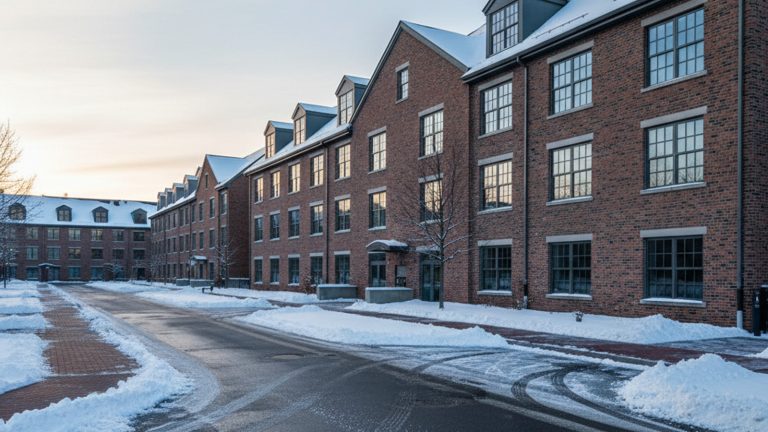


If you are looking at moving to Southern New Hampshire, you have almost certainly bumped into the Manchester versus Bedford debate. It is one of the most common comparisons I walk through with clients because these two communities offer such distinct lifestyles despite being direct neighbors.
On one side of the Merrimack River, you have Manchester—the state’s largest city, buzzing with historic mill architecture, restaurants, and urban energy. On the other side, just across the highway, lies Bedford—the premier suburb known for its rolling wooded lots, stately homes, and quiet cul-de-sacs.
The decision often comes down to what you value more: the convenience and lower entry price of the city, or the privacy and prestige of the suburbs. This guide breaks down the housing costs, tax implications, and daily vibes to help you figure out which side of the river feels like home.
At a Glance: Manchester vs. Bedford Comparison
When you zoom out, the difference between these two markets is stark. Manchester is dense and diverse, offering everything from high-rise condos to compact neighborhoods. Bedford is the definition of sprawl, where zoning laws often require larger lots, keeping neighborhoods quiet and spread out.
Financially, the gap is just as noticeable. Manchester is generally where you find more approachable entry-level pricing and investment opportunities. Bedford commands a premium, often positioning itself as a luxury market.
Here is a quick look at how the numbers generally stack up:
- Median Home Price: You can often find decent single-family homes in Manchester around $440,000, while Bedford homes typically range from $520,000 to over $670,000.
- Tax Rates (2024 Est.): Manchester sits higher at roughly $18.86 per $1,000, whereas Bedford is lower at about $15.81 per $1,000.
- Vibe: Manchester offers nightlife, dining, and walkability. Bedford offers shopping plazas, country clubs, and hiking trails.
Real Estate Market: Buying and Renting
If you are browsing homes for sale in Manchester NH, you are going to see a huge variety of inventory. The city is filled with multi-family homes (great for house-hacking), converted brick mill lofts downtown, and post-war ranches in the outer neighborhoods. It is a fantastic market for first-time buyers who need to stay under a half-million dollar budget, as well as investors looking for rental income.
Bedford NH real estate listings tell a different story. The market here is dominated by large single-family homes, often Colonials or Capes, sitting on lots that are frequently an acre or more. You won’t find many condos or small starter homes here. Because the inventory leans toward the high end, the “move-up” buyer is the typical demographic.
For renters, the contrast is even sharper. Manchester has a robust rental market with options ranging from modern luxury apartments to affordable duplex units. A typical two-bedroom might run around $2,000 a month depending on the neighborhood. In Bedford, rentals are incredibly scarce. You might find the occasional house for rent, but they are rare and command a significant premium.
Both markets are competitive, but they move at different speeds. Manchester homes under the $400,000 mark fly off the shelves because that price point is disappearing across the state. Bedford homes move quickly too, but the higher price tag sometimes allows for a slightly less frantic negotiation process compared to the entry-level frenzy next door.
Cost of Living and Property Taxes
This is the section that surprises most out-of-state buyers. There is a persistent myth in New Hampshire that you should simply “move to the town with the lower tax rate.” While it is true that Bedford has a lower tax rate than Manchester, that is only half the math.
The tax rate in Manchester is higher (around $18.86 per $1,000 of value), but the average home assessment is lower. In Bedford, the rate is lower (around $15.81 per $1,000), but the homes are assessed at much higher values.
Let’s look at how this plays out in real dollars. If you buy a home in Manchester for $400,000, your annual tax bill might be roughly $7,500. However, you likely cannot buy that same house in Bedford. A comparable 4-bedroom home in Bedford might cost $700,000. Even with the lower rate, your annual tax bill would be over $11,000. You are saving on the rate, but paying more on the bill.
Outside of housing, day-to-day costs are fairly similar since you are shopping in the same region. Utility rates, gasoline, and grocery prices are comparable. However, your discretionary spending might naturally creep up living in Manchester simply because you are closer to a higher concentration of restaurants and entertainment venues.
Education and School Districts
For many relocating families, schools are the primary driver of the decision. Both towns have distinct educational personalities.
The Bedford School District is consistently one of the highest-rated in New Hampshire. It is smaller than Manchester’s system and is known for its International Baccalaureate (IB) programs and strong college preparatory focus. The environment is what you would expect from an affluent suburb—well-funded facilities and high parent involvement.
The Manchester School District is much larger and serves a very diverse student body. While its aggregate test scores may not match Bedford’s, the district offers opportunities that smaller towns cannot. A prime example is the Manchester School of Technology (MST), which provides incredible vocational and technical training. Manchester also has highly regarded specialized programs within its high schools.
If you are interested in private education, Manchester is a central hub. Many of the region’s top private and charter schools, such as The Derryfield School or Trinity High School, are located within the city limits, making them easily accessible regardless of which side of the river you live on.
Commuting to Boston and Beyond
If you are reading this, there is a good chance you are planning a commute to Boston. The good news is that both towns are viable commuter bases, roughly 50 to 55 miles from the city, which usually translates to about an hour drive without heavy traffic.
Manchester residents typically shoot straight down I-93. It is a direct route, though it can get congested around the Salem/Windham border. Bedford commuters have a choice: they can take Route 3 (the Everett Turnpike) to merge onto Route 128, or cut across to I-93. Route 3 does have tolls, which is a budget factor to keep in mind.
Public transit is a huge asset for this area. The Boston Express bus service is a lifeline for professionals who want to work on their laptop during the commute. Manchester has a terminal downtown, and there is another major terminal in North Londonderry right off the highway. Most Bedford residents drive the short distance to Manchester or Londonderry to catch the bus. This service is a great option for daily commuters.
For air travel, you really can’t beat the location. The Manchester-Boston Regional Airport (MHT) is practically located on the border of the two towns. Whether you live in a condo in Manchester or a colonial in Bedford, you are likely less than 15 minutes from the departure gate.
Lifestyle: City Energy vs. Suburban Quiet
The “vibe check” is usually where the final decision is made.
Living in Manchester means you have access to Elm Street, the cultural heartbeat of the city. You can walk to dinner, catch a show at the Palace Theatre, or watch the Fisher Cats play minor league baseball at the stadium. It feels like an actual city. There are pockets of urban grit, yes, but there are also historic neighborhoods like the North End that offer beautiful architecture just minutes from the action.
Bedford offers a completely different pace. It is a town where you drive everywhere—there are very few sidewalks outside of specific subdivisions. The lifestyle revolves around upscale retail plazas (home to Whole Foods and Trader Joe’s), country clubs, and quiet evenings at home. It is safe, predictable, and green.
Speaking of safety, Bedford statistically has very low crime rates, which is typical for a town of its design. Manchester, being a city, has areas with higher crime rates, but it also has tens of thousands of residents living in safe, quiet neighborhoods. Areas like Rimmon Heights or the North End often offer a middle-ground feel—residential quiet with urban access.
The Verdict: Who Fits Where?
Choosing between these two really depends on your stage of life and what you want your weekends to look like.
You should choose Manchester if:
- You want walkability and easy access to nightlife and dining.
- You are looking for a more affordable entry point into the housing market.
- You are an investor looking for multi-family properties.
- You prefer a diverse community with a bit of urban energy.
You should choose Bedford if:
- You prioritize privacy, large yards, and quiet streets.
- Top-tier public school ratings are your non-negotiable requirement.
- You have a higher budget and want a “forever home” with significant square footage.
- You don’t mind driving for most errands and amenities.
The Middle Ground: If you are torn, look closely at Manchester’s North End. It offers larger, historic homes that rival Bedford in size and charm, but you remain part of the city with lower taxes relative to the home size and a quick Uber ride to downtown.
Frequently Asked Questions
Yes, generally speaking, Bedford is more expensive. The median home price in Bedford is significantly higher (often ranging between $520,000 and $670,000) compared to Manchester, where you can find homes in the $440,000 range. Renting is also much pricier and harder to find in Bedford.
Bedford has a lower tax rate (around $15.81 per $1,000), while Manchester’s rate is higher (around $18.86 per $1,000). However, because home values are much higher in Bedford, the actual annual tax bill is often thousands of dollars higher than for a comparable sized home in Manchester.
Both are excellent options, but it depends on your preferred route. Manchester offers a straight shot down I-93, while Bedford gives you easy access to Route 3 and the Everett Turnpike. Both towns have easy access to the Boston Express bus terminals, which is a favorite option for daily commuters.
No, Bedford does not have a traditional walkable downtown or “Main Street.” It is designed as a suburban community with commercial activity centered around shopping plazas on Route 101, whereas Manchester features a dense, historic downtown along Elm Street.